Home
/
Fish species
/
Chalk Bass
Chalk Bass
Origin
Australia
Habitat Size
90cm
Water Type
Salt Water
Water Temperature
5º-25ºC
Cost in India
₹3,000 - ₹6,000
Size
10 - 12 cm (Small)
Diet
Herbivore
Quick Information
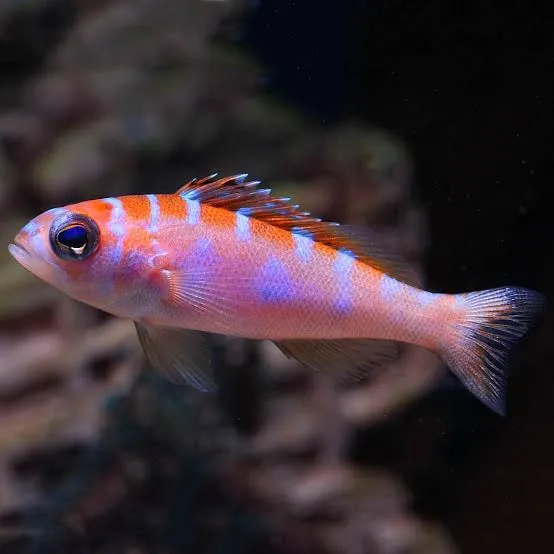
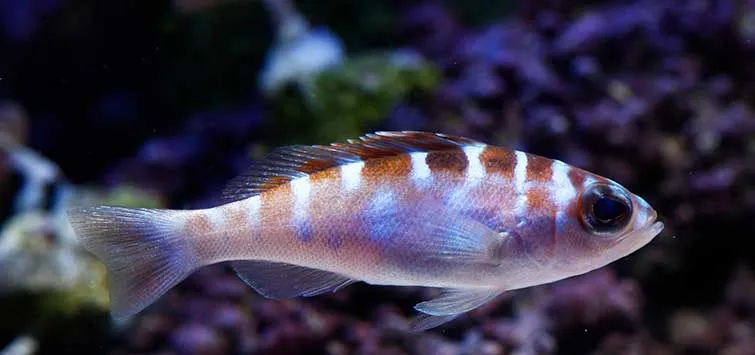
Serranus tortugarum has a laterally compressed elongate body with a pointed snout which is shorter than the diameter of the eye. It has 3 clearly visible spines on the gill cover, the middle spine being straight. The margins of the preopercle are regularly serrated but there are no spines at its angle. The dorsal fin has 10 spines and 12 soft rays while the anal fin contains 3 spines and 7 soft rays. The caudal fin is truncate.[2] This species shows a variable coloration and patterning and can change the colour and pattern on its body in relation to its environment as a means of camouflage.
Characteristics
Temperament
Aggressive
Friendly
Compatibility with other fishes
Not Friendly
Super Friendly
Habitat Size
Small
Large


Habitat
Initial Setup Cost
₹1,000 - ₹3,000
Water Temperature
5º -25ºC
Water Type
Salt Water
PH Level
5 - 12
Serranus tortugarum is found over substrates of rock, silt or sand[4] at depths of 2 to 400 metres (6.6 to 1,312.3 ft), although it is normally found at depths of less than 90 metres (300 ft).[1] This is a social species that is normally recorded in loose aggregations which have a clear hierarchy. It is a synchronous hermaphrodite, this means that each fish has both male and female reproductive organs at the same time. However, self fertlisation has not been recorded. Chalk bass feed on zooplankton, although larger fish have been recorded feeding on more sizeable crustaceans which they swallowed whole.[5] They frequently hover over sandy or rubble areas of seabed and use a nearby conch shell for shelter.[6]
Essential Equipment
Aquarium tank
Water filter
Nutrition
Avg Monthly Expenses
₹3,000 - ₹ 6,000
Chalk Bass are carnivorous and require a varied diet that includes live or frozen meaty foods such as brine shrimp, mysis shrimp, and krill. They may also accept high-quality prepared foods such as pellets or flakes. It's important to offer a variety of foods to ensure they receive all the nutrients they need.


Health
Common Health Issues
Fin rot
Fungus
Velvet disease (yellowish-brown spots on the skin)
Bacterial infections
Signs of good health
Active
Signs of sickness
Loss of appetite
Yellowish-brown spots on the skin
Long, stringy white feces
Reduced activity
White film
Fins become frayed or their color may fade
Serranus tortugarum has a laterally compressed elongate body with a pointed snout which is shorter than the diameter of the eye. It has 3 clearly visible spines on the gill cover, the middle spine being straight. The margins of the preopercle are regularly serrated but there are no spines at its angle. The dorsal fin has 10 spines and 12 soft rays while the anal fin contains 3 spines and 7 soft rays. The caudal fin is truncate.[2] This species shows a variable coloration and patterning and can change the colour and pattern on its body in relation to its environment as a means of camouflage.[3] The typical colour is that the head and body are pale blue-grey, to pinkish brown with 8 narrow, vertical blue-grey bars on the upper body, the most forward just to the rear of the eye and the last one on the base of the caudal fin. Where they are underneath the dorsal fin they extend onto it. There is a row of 2-3 pale blotches on the flanks and the colour of the fins varies from transparent to pinkish.[2] The chalk bass attains a maximum total length of 8.0 centimetres (3.1 in).[4]
Prerequisites for a Fish
Adequate tank space
Financial Capability
Cleanliness
Frequently Asked Questions
Are bass fish intelligent?Are bass fish intelligent?
Yes, bass are capable of learned behavior. But they definitely aren't the “Einsteins” of the fish world. Carp and bluegill rank higher in laboratory tests. Most importantly, though, bass (and other fish species) don't “think” and they aren't “smart
What is chalk fish?
Serranus tortugarum, the chalk bass, is a species of marine ray-finned fish, a sea bass from the subfamily Serraninae, classified as part of the family Serranidae which includes the groupers and anthias. It is found in the western Atlantic Ocean. This species is found in the aquarium trade.